Wood Rot vs Termite Damage in Florida WDO Reports
Updated July 2026
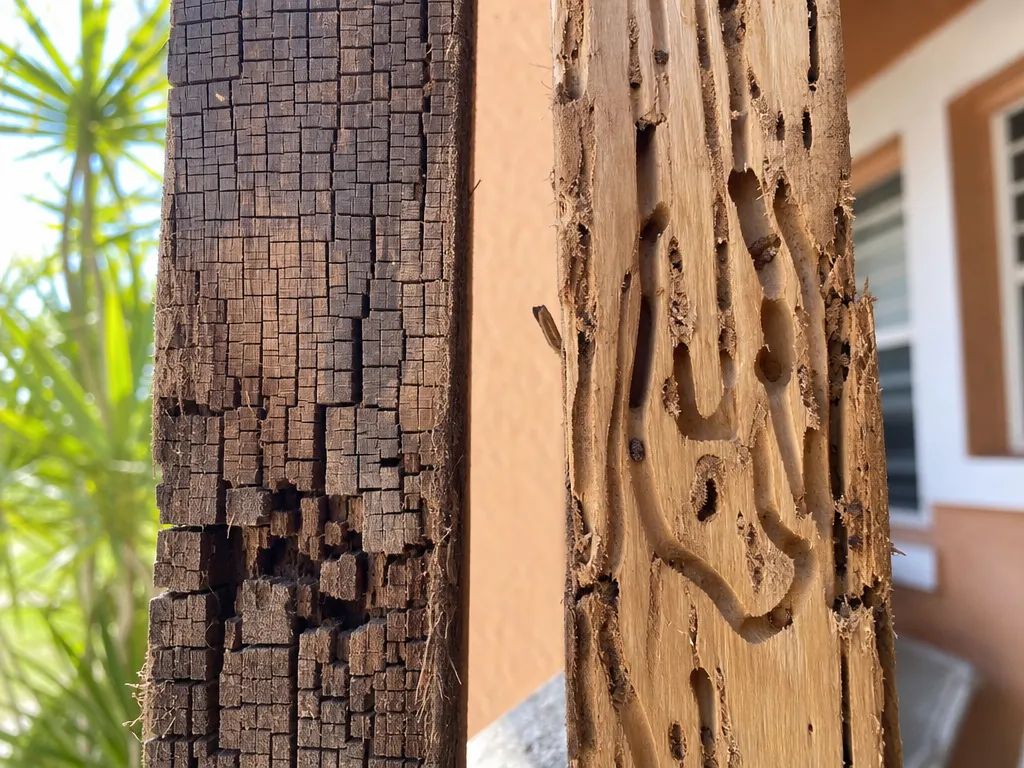
Wood rot and termite damage both appear on a Florida WDO report because, by law, wood-decaying fungi are a wood-destroying organism — the same category as termites. But they leave different clues. Rot is fungal: the wood turns soft and crumbly and typically cracks into brown cubes or a stringy, bleached mush, and it always traces back to moisture. Termites leave galleries that follow the wood grain, plus mud tubes (subterranean) or six-sided fecal pellets (drywood). Inspectors separate the two by appearance, moisture reading, and pattern — and both matter to your lender because both can weaken load-bearing wood.
Why wood rot appears on a WDO report at all
Wood rot belongs on a WDO report because Florida’s statutory definition puts fungi in the same bucket as insects. Under Florida Statute 482.021, a wood-destroying organism is “arthropod or plant life which damages and can reinfest seasoned wood in a structure, namely termites, powder-post beetles, oldhouse borers, and wood-decaying fungi.” That last item is why an inspector filling out FDACS Form 13645 checks for decay just as carefully as for termites, and why a report can flag a moisture-and-fungus problem even when there is not a single insect on the property.
This surprises many buyers who assume a WDO or “termite” letter is only about bugs. In humid Florida, fungal decay is often the more common finding, especially around bath traps, water heaters, roof leaks, sill plates near grade, and crawl-space framing. A report noting “wood-decaying fungi” is not a clerical afterthought — it is a structural flag that follows the same live-versus-evidence-versus-damage logic as any other WDO finding.
What wood rot looks like: brown rot, white rot, and the moisture link
Rot is easiest to recognize by texture and color, and it always sits where water has been. Decay fungi digest the wood itself, so affected members feel soft, punky, or crumbly. According to the USDA Forest Products Laboratory’s Wood Handbook, Chapter 14, inspectors see two major types:
- Brown rot — the fungus “extensively” removes cellulose, so “the wood takes on a browner” color and, in the classic pattern, cracks into cube-like blocks (cubical checking) that crumble to a dry powder when poked. It is often loosely called “dry rot,” but the FPL notes that term “is incorrect because wood must have available moisture for decay, although it may become dry later.”
- White rot — the fungus removes both lignin and cellulose, so “the wood may lose color and appear bleached,” turning spongy, stringy, or fibrous rather than cubical.
A key Florida wrinkle is water-conducting fungi: the FPL explains that some brown-rot fungi “form water-conducting strands” that carry water — usually from soil — into wood “that would otherwise be dry,” so decay spreads beyond the obviously wet spot. Inspectors may also find fruiting bodies — “mushrooms, brackets, or crusts,” per the FPL — or fan-shaped mycelial growth on the surface.
The moisture rule is what ties it together. The FPL states plainly that “serious decay occurs only when the moisture content of the wood is above the fiber saturation point (average 30%),” while “fully air-dried wood usually will have a moisture content not exceeding 20%” and therefore “will not decay if it is kept air dry.” That is why an inspector carries a moisture meter: a high reading plus soft wood and fruiting bodies is what turns a suspicious stain into a reported fungal finding, and why fixing the water source is the first thing that stops active decay.
What termite damage looks like: galleries, tubes, and pellets
Termite damage reads differently: it is patterned, hollow, and comes with insect calling cards. Where fungi turn wood to crumble, termites excavate galleries — tunnels that generally run with the grain, leaving a thin surface shell so the wood sounds hollow when tapped. The two Florida groups leave different signatures:
- Subterranean termites nest in soil and travel up through mud tubes — pencil-width shelter tubes along foundations, piers, and walls — and their galleries are typically lined or packed with soil and mud. UF/IFAS’s guide to native subterranean termites describes these shelter tubes as “highways connecting the underground termite population with aboveground food sources.”
- Drywood termites live entirely inside the wood and eject six-sided fecal pellets (frass) through 1–2 mm kickout holes, leaving clean, soil-free galleries. For the full field guide to those signs, see our companion article on drywood termite evidence.
The presence of soil, tubes, or sand-like pellets is the tell that you are looking at insects, not fungi. Rot leaves none of those — no tubes, no pellets, no shed wings — just softened, discolored, moisture-damaged wood.
Rot vs termite damage: the side-by-side
Most confusion clears up with a direct comparison. The table below sums up how a Florida inspector distinguishes fungal decay from termite activity in the field.
| Feature | Wood rot (fungi) | Termite damage |
|---|---|---|
| Cause | Wood-decaying fungi + sustained moisture | Termites feeding on wood |
| Texture | Soft, punky, crumbly; cubical (brown rot) or stringy/spongy (white rot) | Firm shell over hollow galleries |
| Color | Dark brown and cracked, or bleached and pale | Usually near-normal until broken open |
| Pattern | Follows moisture zones, not grain | Galleries run with the grain |
| Soil / mud | None | Mud tubes and soil-packed galleries (subterranean) |
| Pellets | None | Six-sided frass pellets (drywood) |
| Live-organism clue | Fruiting bodies (mushrooms, brackets), mycelial fans | Live termites, swarmers, shed wings |
| Moisture meter | High (wood above ~30% MC) | Not required for drywood; subterranean seeks moisture |
A third suspect: carpenter ants
Carpenter ants are the confuser between rot and termites, because they show up in the same damp, decayed wood. They do not eat wood — the USDA Forest Products Laboratory notes they tunnel “for shelter rather than for food, usually preferring wood that is naturally soft or has been made soft by decay.” Two field cues separate them:
- Their frass is a giveaway. Carpenter ants push out coarse debris — a mix of wood shavings and insect parts, like bits of dead ants — not the uniform six-sided pellets of drywood termites. Sawdust laced with insect fragments points to ants; clean geometric pellets point to drywood.
- Their galleries are smooth and clean. Because they only excavate, the tunnels look almost sanded, with no soil lining and no pellets inside.
Scope matters here. Florida’s statutory definition of a wood-destroying organism names only “termites, powder-post beetles, oldhouse borers, and wood-decaying fungi” — carpenter ants are not on that list, so their activity is generally not a reportable WDO finding on Form 13645. But because they colonize wood already softened by moisture or decay, an inspector who finds them is often looking at a reportable fungal-decay condition in the same spot. If you see that insect-laced sawdust, ask the inspector how they note carpenter ants and any related moisture damage.
Moisture: the shared root cause
Even though fungi and termites are different organisms, water is the common enemy that invites both. Decay cannot start until wood passes the fiber saturation point — on average about 30% moisture content per the FPL — while wood kept air-dry at or below 20% stays out of the danger zone. Florida’s subterranean termites likewise need “moisture, whether from the wood on which they are feeding or the soil where they nest.” Leaks, poor drainage, soil against siding, blocked ventilation, and grade sloping toward the foundation all raise wood moisture and set the table for both at once. The overlap helps homeowners: the FPL notes that “the precautions effective against subterranean termites are also helpful against decay.” Fix the water, and you cut two risks with one repair.
How fungal findings are written on Form 13645
Fungi are reported with the same three-part logic as any WDO. Under Florida Statute 482.226, the report must state the identity of any wood-destroying organisms present, any visible damage, and any visible evidence of previous infestation or treatment — and wood-decaying fungi are one of those organisms. In practice, an inspector distinguishes active decay from an old, dried-out stain: fungal decay is generally treated as active when a moisture meter reads the wood wet enough to sustain growth and fungal fruiting bodies or fresh mycelium are present, whereas dried, stable wood with no elevated moisture is more likely written as evidence of a past problem. As with termites, the report covers only what was visible and readily accessible. For a section-by-section walkthrough of the form, see our guide to the WDO report and Form 13645.
Why your lender cares — and who re-inspects after repairs
Lenders care because rot is a structural issue, not a cosmetic one. The FPL warns that decay quietly destroys strength before it looks dramatic: “by the time weight losses resulting from decay have reached 10%, most strength losses may be expected to exceed 50%,” and “wood with visually discernible decay has been greatly reduced in all strength values.” A soft sill plate or joist can fail long before it looks alarming, which is why many loan programs — see when a WDO inspection is required — want visible WDO damage evaluated and corrected before closing.
The path after a finding is repair, then re-inspection. Once the moisture source is fixed and damaged members are repaired or replaced, a licensed WDO inspector returns to verify the correction and update or re-issue the report. That follow-up inspection is what gives a lender and buyer documented closure.
Preventing moisture damage
Because both problems start with water, prevention is moisture control. The FPL and UF/IFAS point to the same measures: keep structural wood out of direct soil contact, maintain a soil moisture barrier in crawl spaces, and ensure “proper drainage of rainwater away from” the structure with working gutters, downspouts, and grade that slopes away from the foundation. Add ventilation and prompt repair of plumbing and roof leaks. None of this is a treatment prescription — it is upkeep that keeps wood below the moisture threshold where fungi and termites get started.
Bottom Line
Wood rot and termite damage share a WDO report and a root cause — moisture — but they look nothing alike up close: rot crumbles into brown cubes or bleached strings with no pellets or tubes, while termites leave grain-following galleries, mud tubes, or six-sided frass. Both weaken structural wood, so both belong in your closing decisions. The reliable way to know which one you are dealing with, and how active it is, is a thorough inspection by a licensed professional. Find a licensed Florida WDO inspector to get a clear reading before you sign.
Frequently Asked Questions
Can a house have both wood rot and termites at once?
Yes, and it is common. Both problems start with moisture, so a damp sill plate or crawl-space joist can host wood-decaying fungi and subterranean termites at the same time. A WDO inspector reports each finding separately on Form 13645, since fungi and termites are distinct wood-destroying organisms.
How do you tell wood rot from termite damage?
Rot makes wood soft, crumbly, and often cracked into brown cubes or a stringy, bleached texture, and it always sits near moisture. Termites leave galleries that follow the grain, plus mud tubes (subterranean) or six-sided pellets (drywood). No pellets or tubes usually means fungi, not insects.
What is the difference between brown rot and white rot?
Brown rot removes the cellulose, leaving wood dark, dry, and cracked into cube-like blocks that crumble to powder. White rot removes lignin and cellulose, leaving wood bleached, spongy, and stringy. Both need sustained moisture to grow.
At what moisture level does wood start to rot?
Decay fungi need wood moisture above the fiber saturation point, on average about 30 percent. Fully air-dried wood stays under 20 percent and will not decay, which is why fixing leaks and drainage stops active rot.
Does wood rot affect the loan or the sale?
It can. Fungal decay weakens structural wood, and lenders on many loans want visible damage evaluated and repaired before closing. After repairs, a licensed inspector re-inspects and updates the report.
Sources & review
Facts in this guide are checked against primary sources — leg.state.fl.us, research.fs.usda.gov, edis.ifas.ufl.edu — linked inline where cited. Last reviewed July 2026. We are an independent directory: no inspection company pays for placement or editorial coverage.
Related Reading
Get a WDO Inspection Quote
Tell us about the property — we’ll connect you with licensed Florida WDO inspection companies for free quotes. No obligation.